What Is Anodizing? A Complete Comparison Between Aluminum Anodizing and Hard Anodizing
Article list

If you are holding an aluminum water bottle, a laptop casing, or a bicycle handlebar in your hand, and it feels smooth, has a uniform color, and even carries a subtle metallic luster——there is a high probability that this component has undergone "anodizing."
But what exactly is "anodizing"? And how does it differ from "hard anodizing"? If you are currently selecting a surface treatment process for your product, this article will explain the principles, differences, and application scenarios in the easiest way to understand, all in one place.
What is Anodizing?
Let's start with an easy-to-understand analogy: Aluminum alloy as a material is naturally prone to oxidation——just like a peeled apple turns brown when left in the air. As long as aluminum comes into contact with air, a thin oxide layer naturally forms on its surface. This natural oxide layer is very fragile, easily peels off, and provides limited protection.
Simply put, what Anodizing does is actively and controllably thicken and densify this oxide layer using electrochemical methods, rather than letting it form naturally.
How is it done specifically? The aluminum alloy workpiece is placed in an electrolyte solution and supplied with direct current, making the workpiece the "anode" (positive electrode). At this time, oxygen ions in the electrolyte continuously react with the aluminum, growing an aluminum oxide (Al₂O₃) coating on the surface. This layer is artificially "grown," making it much thicker and far denser than the natural oxide layer. The coating thickness is only between a few micrometers to tens of micrometers (1 micrometer is about one-hundredth the diameter of a human hair), invisible to the naked eye, but the protective capability is worlds apart.
Taking the standard anodizing process actually produced by Leedo Technology (Type II Sulfuric Acid Anodizing) as an example, the coating thickness can be precisely controlled between 6 to 25 micrometers (µm), adjusted according to application needs.
Once this layer grows, it brings several distinct benefits:
- Corrosion Resistance: The dense oxide film acts like a protective shield, blocking moisture and air from further oxidizing the aluminum material.
- Wear Resistance: The surface hardness is significantly higher than that of pure aluminum itself.
- Aesthetics: The coating structure is porous, which can absorb dyes to create various colors (this part will be explained in detail later).
- Insulation: Aluminum oxide itself does not conduct electricity, providing a degree of electrical insulation.
So to the question "What is anodizing?", the simplest answer is: Using electrolysis to artificially grow a thicker, denser, and more durable protective film on aluminum alloy, while also allowing it to be dyed in the process.
What are the Advantages and Disadvantages of Anodizing?
After understanding the principles, we must also honestly face its advantages and limitations in order to judge whether a component is truly suitable for anodizing.
Advantages:
- Significantly Enhanced Corrosion Resistance: The dense oxide film blocks moisture and air, providing far stronger protection than a natural oxide layer.
- Improved Wear Resistance: The oxide film hardness is higher than the aluminum material itself. Standard anodizing provides basic wear resistance, while hard anodizing can reach 400–550 HV.
- Versatile Appearance Options: Can be dyed in a variety of colors (clear, black, silver, custom shades), and glossy, matte, or fine sand textures can also be selected based on requirements.
- Good Environmental Compatibility: The electrochemical process does not require additional electroplating of heavy metals; the coating integrates fully with the substrate and does not peel off easily.
Disadvantages (Limitations):
- Alters Component Dimensions: The oxide film grows both inward and outward from the aluminum substrate. The actual dimensional change ratio varies based on material, coating thickness, and process conditions. Dimensional compensation space must be reserved on design drawings; otherwise, precise tolerances will be affected.
- Uniformity of Coating Thickness or Dyeing is Difficult in Deep Holes, Narrow Slots, and Complex Curved Surfaces: These structures are prone to inconsistencies in coating thickness or color due to differences in current distribution. It is recommended to perform a Design for Manufacturability (DFM) evaluation and sample verification during the design phase.
- The Oxide Film Itself is Non-Conductive: The anodized layer possesses insulating properties. If a component has electrical conductivity, grounding, or EMI requirements, masking areas or post-machining treatments must be planned in advance during the design phase.
- Not a Universal Method: Non-aluminum materials (such as stainless steel or copper) are not suitable for standard aluminum anodizing processes, and other surface treatment methods need to be evaluated.
Simply put, the advantages of anodizing are concentrated in three major areas: corrosion resistance, wear resistance, and appearance. Limitations, on the other hand, are mostly related to "dimensional accuracy," "complex geometric structures," and "electrical conductivity requirements"——these limitations are not insurmountable and can generally be overcome through dimensional compensation and masking design, as long as they are evaluated early in the design stage.
Standard Anodizing vs. Hard Anodizing: What is the Difference?
Once you understand "what anodizing is," the next most frequently asked question is: What exactly is the difference between standard anodizing and hard anodizing (also referred to as "hardcoat anodizing")? Which one should you choose?
The electrochemical principles of both share the same logic. The differences primarily stem from adjustments in process conditions——hard anodizing uses lower bath temperatures and higher current densities, causing the coating to grow thicker and form a denser structure. In the industry, they are categorized according to standards as Type II (standard anodizing) and Type III (hard anodizing), both of which can be process-controlled and verified according to standards such as MIL-A-8625.
Here is a quick comparison table (data based on actual production specifications from Leedo Technology):
| Item | Standard Anodizing (Type II) | Hard Anodizing (Type III) |
| Coating Thickness | 6–25µm | 25–80µm, high specifications can reach 50–80µm |
| Surface Hardness | Moderate, oriented toward decoration and basic protection | Approx. 400–550 HV, wear resistance is significantly improved |
| Appearance | Glossy and matte options available; suitable for dyeing in various colors | Mainly black, dark gray, and natural shades; functionality prioritized |
| Special Options | Custom dyeing, clear anodizing | Can integrate PTFE composite treatment to further reduce the coefficient of friction |
| Primary Focus | Appearance + basic corrosion resistance | Wear resistance, durability, industrial-grade protection |
| Common Applications | 3C housings, bicycle components, consumer electronics | Industrial parts required to withstand friction, sliding, and mechanical operations, such as automation equipment and aerospace structural parts |
In plain language: Standard anodizing is like applying a coat of protective colored paint to a part, balancing aesthetics and basic protection; hard anodizing is more like putting a layer of wear-resistant armor on the part, where the coating thickness can be 3 to 4 times that of standard anodizing, with significantly higher hardness, trading for superior wear resistance and durability.
How to choose? You can use a simple decision logic:
- Will this component frequently experience friction, sliding, or wear from mechanical operation? (e.g., mechanical slide rails, industrial equipment parts) → Lean toward hard anodizing.
- Is the appearance of this component very important, requiring multiple color options or matte/glossy choices? (e.g., consumer electronics housings) → Lean toward standard anodizing.
- Some parts may even undergo regional treatment based on functional surfaces, applying hard anodizing to critical friction surfaces and standard anodizing to the remaining cosmetic surfaces——this requires clear communication with the surface treatment vendor during the design phase.
What Colors Can Be Achieved with Aluminum Anodizing?
Besides its protective functions, another reason why many people choose standard anodizing is that it can be dyed.
The principle is actually not difficult to understand: The surface structure of the coating grown via anodizing is porous, with extremely fine pore diameters that are completely invisible to the naked eye, but just right for dye molecules to penetrate and adhere inside the pores. After dyeing is completed, a sealing treatment is applied (closing the pores) to lock the color securely within the coating, making it resistant to fading.
According to customer requirements, different textures such as glossy, matte, or satin can be created, paired with various color dyeing effects.
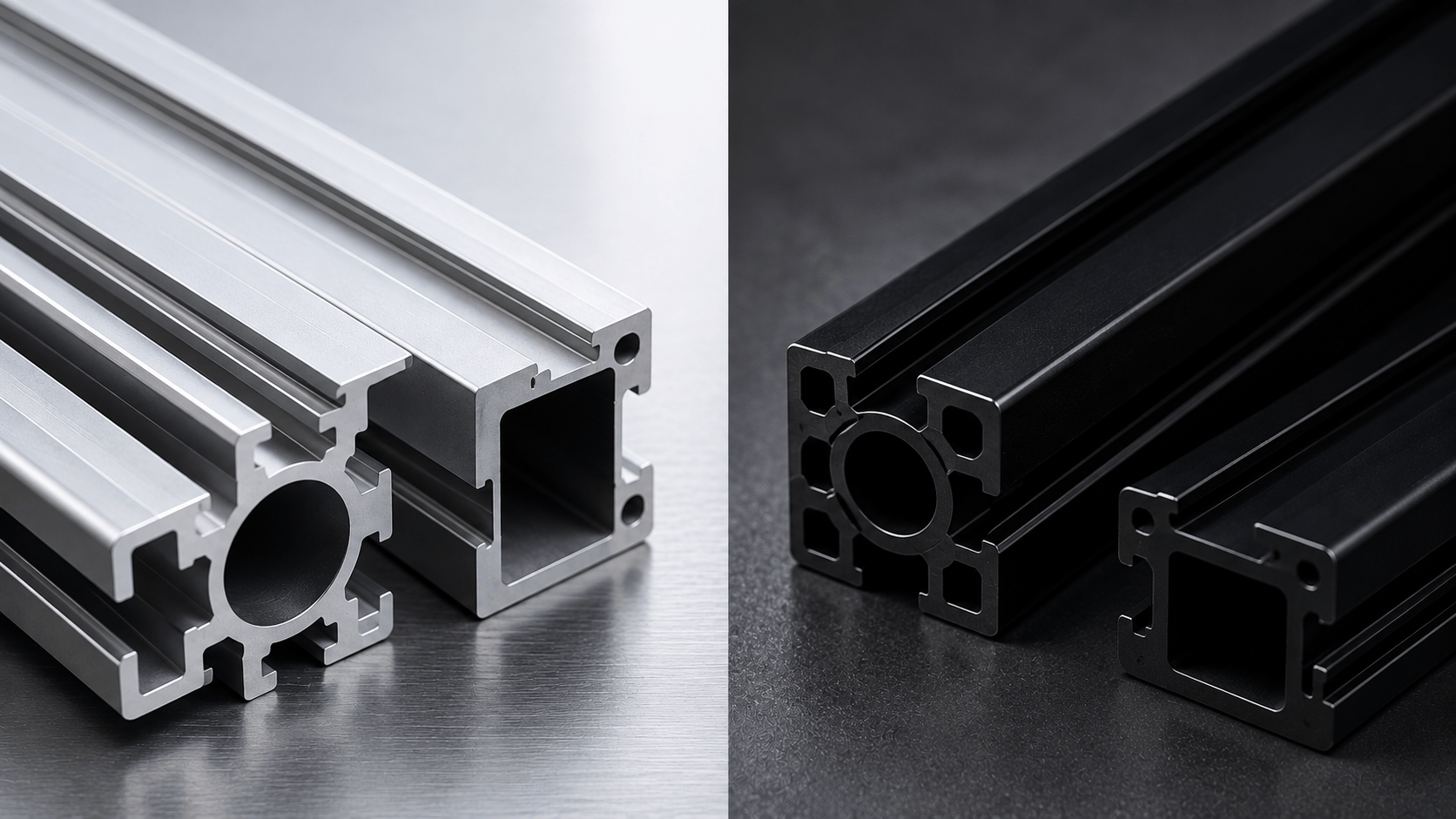
Among them, black anodizing is one of the most common choices in industrial and consumer electronics products. The reason is intuitive——black is understated, timeless, and less prone to showing dirt. At the same time, it easily conveys a visual impression of "precision" and "quality," which is why it appears extensively on laptop covers, camera bodies, industrial equipment panels, and other products. From a process perspective, black anodizing is completed through anodizing + dyeing + sealing, just like other colors; the only difference is the selection of black dye, rather than a different special process.
Which Anodizing Method is Suitable for Different Aluminum Alloys?
While choosing between standard or hard anodizing is crucial, many people tend to overlook another key variable——the material itself. Not every aluminum alloy is suitable for the same anodizing specification, and the characteristics of several common mainstream aluminum alloys vary significantly:
- 6061 Aluminum Alloy: The most versatile structural alloy in the industry, combining both strength and machinability. It is the most common material choice for consumer electronics and industrial mechanical components, capable of reliable processing under both standard and hard anodizing.
- 5052 Aluminum Alloy: Features outstanding corrosion resistance, frequently used in marine environments, chemical equipment, architectural curtain walls, and other applications exposed to corrosive environments long-term.
- 6063 Aluminum Alloy: Excellent extrusion performance, producing a particularly delicate surface after anodizing. It is a common choice for architectural frames, doors, windows, and decorative parts.
- 7075 Aluminum Alloy: A high-strength aerospace-grade alloy suitable for high-stress structural parts. When paired with hard anodizing, the surface hardness can be further increased, commonly seen in aerospace and high-end competitive bicycle parts.
In practice, both standard anodizing and hard anodizing can be applied to these alloys, offering stable processing whether for extruded aluminum profiles or CNC precision-machined aluminum parts. Which processing method to ultimately choose goes back to the decision logic mentioned earlier: check whether the component prioritizes appearance or wear resistance and load-bearing capacity. If a part requires both structural strength and aesthetic appeal, it is recommended to consider the material, machining method, and surface treatment process together in the early design phase to avoid discovering specification incompatibilities during later prototyping.
FAQ
Q1: What is anodizing? How is it different from general oxidation?
Anodizing uses an electrolytic method to artificially control the growth of a thicker and denser oxide film on the aluminum alloy surface. This differs from natural aluminum oxidation (the thin oxide layer formed naturally when left unattended in the air). Natural oxide layers are thin and easily peel off, whereas the anodized coating is electrochemically controlled, offering significantly higher protective power and durability. The coating thickness of standard anodizing (Type II) can be precisely controlled between 6 and 25µm.
Q2: What is the difference between standard anodizing and hard anodizing?
The main differences lie in coating thickness and hardness. Standard anodizing (Type II) has a coating thickness of about 6–25µm, focusing on appearance and basic protection. Hard anodizing (Type III) adjusts current density and bath temperature to produce a thicker and harder coating (25–80µm, hardness approx. 400–500 HV), offering noticeably better wear resistance and the ability to integrate PTFE composite treatment to further reduce friction coefficients. However, color options are relatively limited, mostly black, dark gray, and natural tones. Simply put, the former prioritizes appearance, while the latter prioritizes durability. For common aluminum alloys like 6061, both processes are applicable, and the actual choice depends on the component's appearance and wear resistance needs.
Q3: How is black anodizing achieved? Is it the same as regular dyeing?
Yes, black anodizing follows the exact same process as anodized dyeing for other colors——first completing the anodizing process, then allowing dye to penetrate the porous structure of the coating, and finally sealing to lock in the color, except that black dye is selected. It is not a separate or special blackening process. Because black is timeless and does not easily show dirt, it is a very common choice in industrial and consumer electronics products.
Q4: Are there any disadvantages to anodizing?
The primary limitation is that the oxide film changes the component's dimensions; precision parts require reserved compensation space in design drawings. Additionally, controlling coating thickness or color uniformity in complex geometric structures like deep holes and narrow slots is more difficult, so prototype verification is recommended beforehand. The oxide film itself is non-conductive, so if a part has grounding or EMI requirements, masking areas must be planned during the design stage. Most of these limitations can be overcome through upfront Design for Manufacturability (DFM) evaluations, making anodizing a cost-effective surface treatment method for aluminum alloys overall.